
Campbell Resident Lookup by Record Type
An effective one-person search matches the question to a custodian. A known address can yield an APN and property facts, while Clerk-Recorder deed work exposes grantor and grantee names. VoterStatus is identity-gated. A court index shows party and chronology. Vital indexes point to events. Business, license, probate, obituary, and directory records add clues. No single result proves current residence.
| Record | What It Confirms | Where | Access |
|---|---|---|---|
| Assessor and recorder | Parcel, ownership clue, mailing contact, deed party | Assessor search and Clerk-Recorder office | Address or APN online; deed research in person |
| Voter record | Registration status tied to the requester's residence | California VoterStatus and Registrar | Self lookup or permitted file request, not public browsing |
| Court case | Party role, case chronology, and probate leads | Santa Clara Superior Court | Supported public index; terminal and clerk fallback |
| Vital record or index | Birth, death, marriage, or divorce event clue | County, CDPH, or Superior Court | Copy eligibility and confidentiality rules apply |
| Business or FBN filing | Entity affiliation, agent, and business address | California SOS and County Clerk-Recorder | Free search; filing copies may cost |
| Professional license | License status, dates, and public business contact | California DCA search | Free board, name, number, or location search |
| Directory or census | Listed occupant or household at a historical time | Library collections and NARA | Incomplete snapshot; access varies by collection |
Choose the narrowest source first. A case number beats a broad name search. An address can return an APN, but California's internet assessor rules do not provide an owner-name browse. A vital index may test a relationship, while a certificate may require an authorized request. Seek a second source with a compatible date, role, place, or record number.
Match a Campbell Resident Lookup Across Records
Same-name errors are common in Campbell. Initials can hide another given name. A deed may index a trust, spouse, or business rather than the person at the parcel. A docket records a party and procedure, not a finding. Start with the full name, spelling variants, middle initial, and reason the record should fit.
- Write the exact name and variants. Search the narrowest official index, and save its date, source, and identifier.
- Anchor the name to an address, APN, filing role, or case number. Property results are ownership clues, not occupancy proof.
- Run the court party search. Compare case type, filing date, party role, and status; a name plus docket is not identity proof.
- Use a vital index, license, business filing, obituary, or other record to test chronology. Order a certified copy only from its custodian.
Two concordant official facts support a cautious match. A compatible address and business role can separate same-name people, but absence from a roll proves little. Safe at Home participants, sealed matters, and unlisted people may not appear.
- Docket
- A court case's running record of parties, filings, hearings, and other events.
- Index versus image
- An index is a finding aid; an image is the underlying page and may require a visit, order, or fee.
- Certified copy
- A custodian-attested reproduction used when an official copy is required.
Note: A name match is a lead; a second official record with compatible date, role, or address is needed before identity can be inferred.
Santa Clara Court Searches for Campbell Residents
Campbell cases belong to the Superior Court of California, County of Santa Clara. The Santa Clara Superior Court portal routes searches by case family. Case Number accepts 5-16 alphanumeric characters; Party Search uses First Name and Last Name; Business Search uses Business Name. Filing Date Search uses MM/DD/YYYY, permits a maximum five-day span, and lists Civil, Criminal, Family, Probate, and Traffic.
The remote service warns that only qualifying Civil information under California Rules of Court 2.503 is currently public. Divisions and calendars differ. Results may show case number, title, type, filing date, parties, roles, status, and supported events. Sealed or confidential matters are omitted, so use the clerk or courthouse terminal for an older or restricted public file.
| Portal control | Type | Required | Format or scope |
|---|---|---|---|
| Case Number | Text | Optional search mode | 5-16 alphanumeric characters; preserve the case format |
| Party Search | First and Last Name | Optional search mode | Try full name and spelling variants |
| Business Search | Business Name | Optional search mode | Find cases tied to the named entity |
| Filing Date From/To | Date pair | Optional filter | MM/DD/YYYY; maximum five-day span |
| Case Type | Dropdown | With filing-date search | Civil, Criminal, Family, Probate, or Traffic |
Family records use form FM-1183, which asks for requester, mailing details, case number, title, documents, and certification choice. Without a case number, provide petitioner and respondent names at filing and an estimated start year. A five-year search is $15. Cases through 1996 require Records Department self-search; 1997-forward starts with the portal. Mail with SASE or postage to Superior Court-FJC Records Request, 191 N. First Street, San Jose, CA 95113. The counter at 201 N. First Street is generally open 8:30-3:00. Charges include $0.50 per page, $15 for a dissolution certification, and $40 for another certification.
- Record the case number, title, type, filing date, party role, status, and event date shown.
- Separate an allegation or pleading from a judgment, order, or other disposition.
- Ask about retrieval time and page or certification charges before traveling.
Campbell Vital Records for One Person
Vital records confirm events or relationships, not current residence. Santa Clara County births reach back to 1873. Counter, mail, and approved online-vendor ordering are available. A birth request uses name, birth date and city, gender, and parents' birth names; the fee applies even when no record is found. The county certificate service is local; CDPH Vital Records is statewide.
Health and Safety Code sections 103525-103526 distinguish authorized and informational copies. The latter is marked not valid to establish identity. A mailed authorized request needs a sworn, notarized statement. Confidential marriages are restricted under Family Code section 509. Divorces stay with Superior Court; CDPH supplies a Certificate of Record only for 1962 through June 1984, not a decree.
| Record | Campbell source | Access rule | 2026 county fee |
|---|---|---|---|
| Birth | County from 1873 or CDPH statewide | Authorized or informational copy; mailed authorized request is notarized | $34 |
| Death | County or CDPH | Authorized limits and informational-copy rules apply | $26 |
| Public marriage | County license record or CDPH | Apply under the certificate eligibility rules | $19 |
| Confidential marriage | County Clerk-Recorder | Spouses or court order under Family Code section 509 | $19 where eligible |
| Divorce | Superior Court; CDPH covered-era certificate | Certificate of Record is limited to 1962-June 1984 | See custodian schedule |
Statewide permanent birth and death coverage begins in July 1905. Public marriage coverage is 1905-1999 and 2008-present, leaving a 2000-2007 county gap. An historical index is not an unrestricted certificate image.
Campbell Vital Fees Rose in 2026
Santa Clara County raised local certificate fees on January 1, 2026. Birth certificates moved from $32 to $34, death certificates from $24 to $26, and marriage certificates from $17 to $19. Those are county fees for the listed records. Online vendors can add their own charges, and state applications have a separate fee schedule.
The change matters when a Campbell search moves from an index clue to an official copy. Check the selected county or CDPH application before paying, because counter, mail, vendor, and statewide queues are separate. A paid search does not guarantee a record, and an informational copy does not become identity proof merely because it was ordered.
Note: Match the event, custodian, copy type, eligibility category, and current fee before sending a vital-record request.
Campbell Heirs and Probate Records
Probate is the court path for identifying an heir of a former Campbell owner. A public petition may name the decedent, petitioner or personal representative, counsel, hearing, and sometimes heirs or devisees. Wills and inventories are document-level records, so a public docket does not make every attachment online. Pair a probate name with a deed or vital event.
An heir trail runs from the parcel and latest title-changing instrument to the deceased owner's grantor-grantee chain, then to Superior Court probate. A death index or obituary suggests timing; a recorded transfer may show who received an interest. Ask the clerk whether a known document can be viewed or copied.
For a birth-parent search, use California's official adoption, consent, and court processes. Vital-record rules do not make adoption material an open index.
California Voter Status, Not a Campbell Roster
The California VoterStatus tool is an identity-gated self lookup, not a public name or street directory. It asks for first name, last name, date of birth, and a California driver license or ID number or SSN4, depending on the record. The Santa Clara County Registrar supplies local registration, district, map, data, and request channels.
A record can contain name, residence or mailing address, registration date and status, party preference, precinct or district, and participation history. Elections Code sections 2180-2194 restrict use; signatures, ID numbers, and sensitive identifiers are confidential. A voter-file request needs requester contact, precise data, statutory purpose, security and redisclosure promises, and fee or delivery choices. It is not a casual ZIP browse.
The 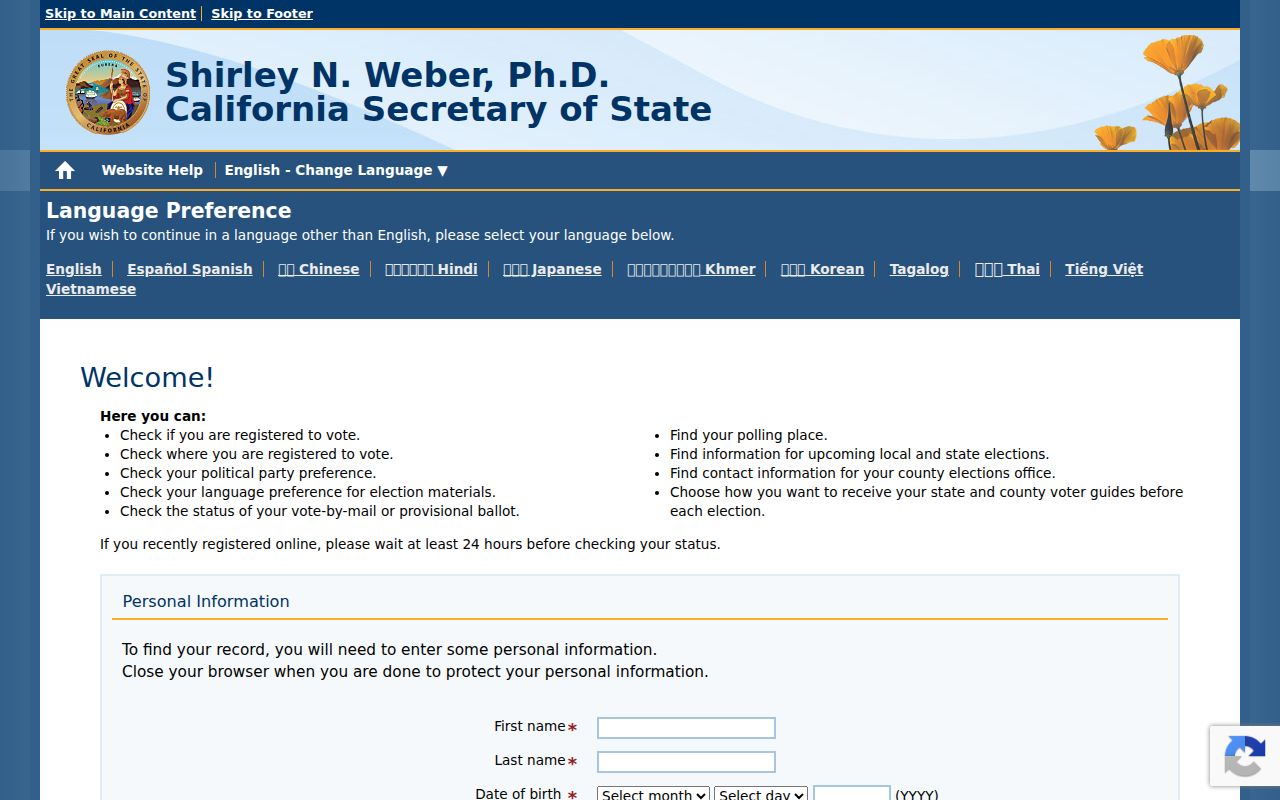
The status form shows why voter data cannot be treated as a public roster. Protected records may follow added confidentiality rules.
Campbell Property Records and Occupancy
A property search can anchor a name, but it cannot make an owner an occupant. The Santa Clara County Assessor accepts situs address or APN, not a public owner-name search. Capture the APN and latest title-changing document number. At the Clerk-Recorder official records service, the deed supplies grantor, grantee, and legal description. The official index has no street field, and the recorder does not perform title searches. Its online index was removed November 5, 2018; records from 1850 use office workstations for 1981-present and Digital Reel or books for 1850-1980 at 110 W. Tasman Drive.
Mailing address is where notices go; situs is the physical parcel; legal description identifies the land. An address-first Campbell street directory search can organize parcel work, but household members, utility customers, and protected people are not reliably exposed. Compare property clues with another official source.
Campbell Business and License Clues
Affiliation records can separate similar names. The DCA License Search offers Board or Bureau, License Type, License Number, Business Name, First Name, Last Name, City, County, and ZIP. Results may show license number and type, status, issue and expiration dates, a public address, and discipline links. A business contact is not a home address.
California SOS bizfile Online shows entity status, formation, jurisdiction, agent, addresses, and filings. The State Controller's Unclaimed Property search uses last or business name, first name, and city; a match may show prior address, holder, and property type. Claims need proof. For Campbell, compare entity, FBN, and city-license records without labeling an agent or storefront a residence.
Campbell Custody Records and Address Privacy
The Santa Clara County inmate finder is a current-custody index searchable by name or booking identifier. It may show custody location, charges, bail, and court data; a charge is not a conviction. The CDCR locator has historical and released-person limits. The Megan's Law site carries statutory warnings and anti-harassment rules.
Safe at Home gives qualifying survivors and other covered people a substitute mailing address and confidential forwarding. Do not infer absence from a missing name. Protected court, juvenile, adoption, victim, utility, and motor-vehicle information may be closed or redacted.
The county finder image shows this record type's narrow current-custody purpose.
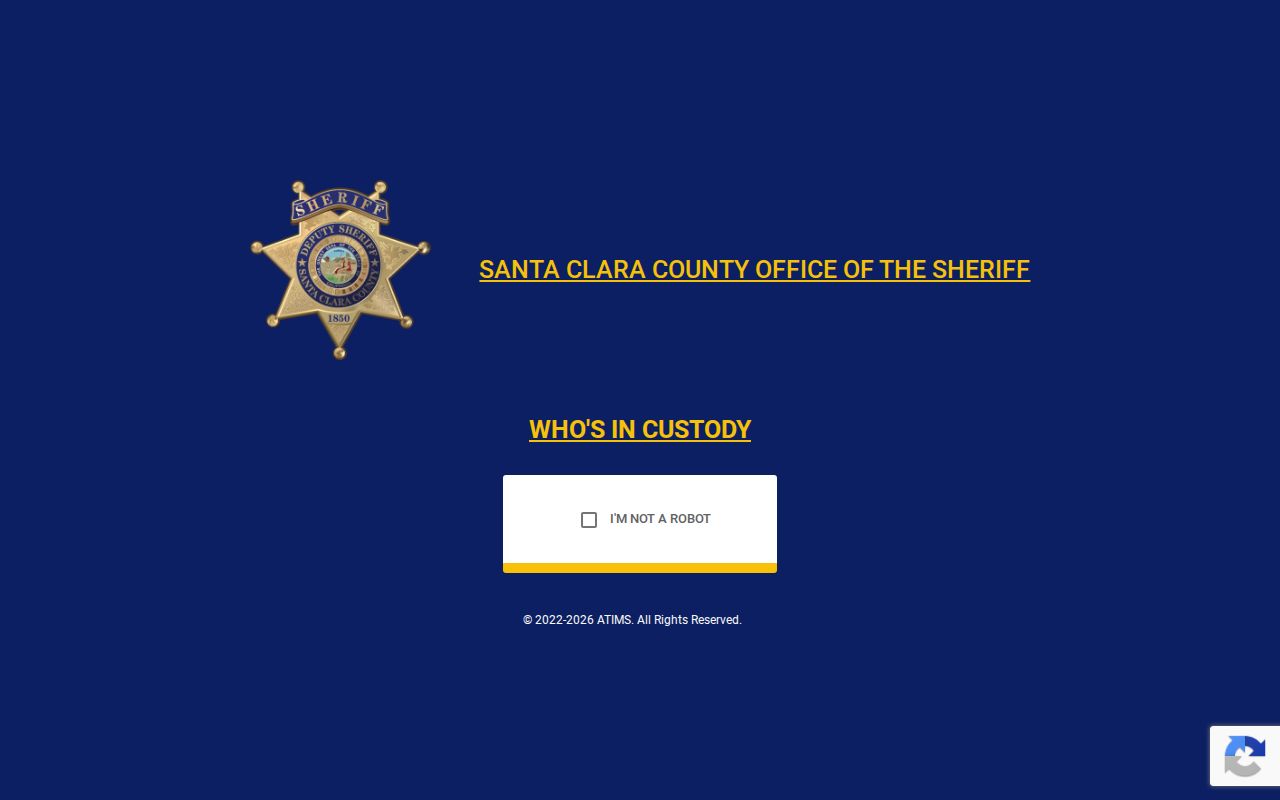
Use the custodian's result and warnings, not a custody or registry entry as a general history.
Campbell Records When the Portal Stops
Online absence is not the end of a one-person search. The California Public Records Act, Government Code sections 7920.000 and following, supports focused requests for existing, nonexempt records. Name the category, date range, address or project, and sender or recipient. An agency need not create a new answer or perform open-ended research.
Section 7922.535 calls for a determination within 10 calendar days, with written notice allowing a 14-day extension for unusual circumstances. Inspection is generally free; duplication or special extraction can cost. Older evidence may require a courthouse terminal, recorder workstation, Digital Reel or book, clerk counter, mail request, or library and archive service.
For a wrong match, take the record number and date to the creating office. The custodian controls correction, redaction, or access.
Use a Campbell Lookup Lawfully
Sealed and confidential court matters, juvenile and adoption material, confidential marriages, protected voter fields, and authorized vital copies are not ordinary browse results. Public availability does not authorize threats, stalking, or harassment. California Penal Code sections 646.9 and 422, and Code of Civil Procedure section 527.6, address these harms and protective orders.
Use records for family history, an heir question, civic research, or lawful reconnection. Verify with the custodian. If Safe at Home shields an address, respect the substitute address and do not defeat it.
Lawful use. A Campbell lookup is for personal, lawful research. Do not use a record to stalk, harass, threaten, intimidate, or harm another person.