
Campbell City Directories in a Regional Shelf
Campbell city directories sit inside a larger San Jose and Santa Clara Valley publication market. A household may be filed in a Campbell section, a suburban or community section, a rural route, or a San Jose telephone exchange. That geography makes a catalog record more useful than a promise of an annual Campbell volume. The confirmed sets below are starting points, not a claim that every intervening year exists. Note the title, publisher, edition year, call number, and image coverage one volume at a time.
| Collection | Years | Where Held | Access |
|---|---|---|---|
| San Jose regional volumes | 1870 and 1887 | San Jose Public Library California Room | Full regional directories; confirm catalog record |
| Polk-Husted San Jose City and Santa Clara County Directory | 1920 | San Jose Public Library California Room | Digital volume with 601 images |
| Regional business-classified sections | 1890, 1892-1913, 1915-1918 | San Jose Public Library California Room | Classified sections only, not full resident runs |
| Campbell Press local-history files | 1895-1896; 1903-May 1986 | Campbell Library, 77 Harrison Avenue | Remote 1895-1896 and 1903-1923; fuller run in library |
| Yearbooks, telephone directory, and later Campbell titles | Title-specific | Campbell Library reference collection | Ask staff to confirm year and location |
The Campbell Press run has a known gap from 1897 through 1902. Later local titles add the Campbell Express/Cambrian News from May 1988, the Campbell Reporter from April 1999, and a July 1973 Campbell Sun issue. These are not interchangeable with a resident directory. A newspaper can place a name in a notice, while a directory can place a listed adult at an address. Use both when the question concerns a household over time.
Campbell City Directory Help at SCCLD
The Campbell Library is a Santa Clara County Library District branch, not the custodian of county deeds or a complete population roll. Its catalog and reference service are the practical first stop for historical directory volumes, telephone books, yearbooks, newspapers, obituary work, and genealogy databases. Reference staff can check the exact year and branch or off-site location before a trip. Library-licensed genealogy tools may require a library card or in-library authentication, so remote access should never be assumed.
Use the Campbell Library location information for branch details and the SCCLD genealogy resources page for database access notes. Reference contact is 408-866-1991 at 77 Harrison Avenue. The fuller digitized local-history run is available in the library, while the remote portion covers Campbell Press issues from 1895-1896 and 1903-1923. Ask for the exact title and date before relying on a search result that uses only a place name.
The branch’s history also helps date its collections. A library began in February 1894 with a $50 Myrick gift, matching public money, and YMCA books. A Women’s Club library opened in 1923 with 4,500 volumes. The Harrison building opened in 1975, doubled in size in 1989, and the renovated all-electric branch reopened May 9, 2026. SCCLD's reopening report and earlier project preview help verify those institutional milestones. Those milestones describe the institution, not the date of a particular directory, so the catalog record still controls.
The Campbell Library genealogy resources give a useful view of the search path for a Campbell directory request.
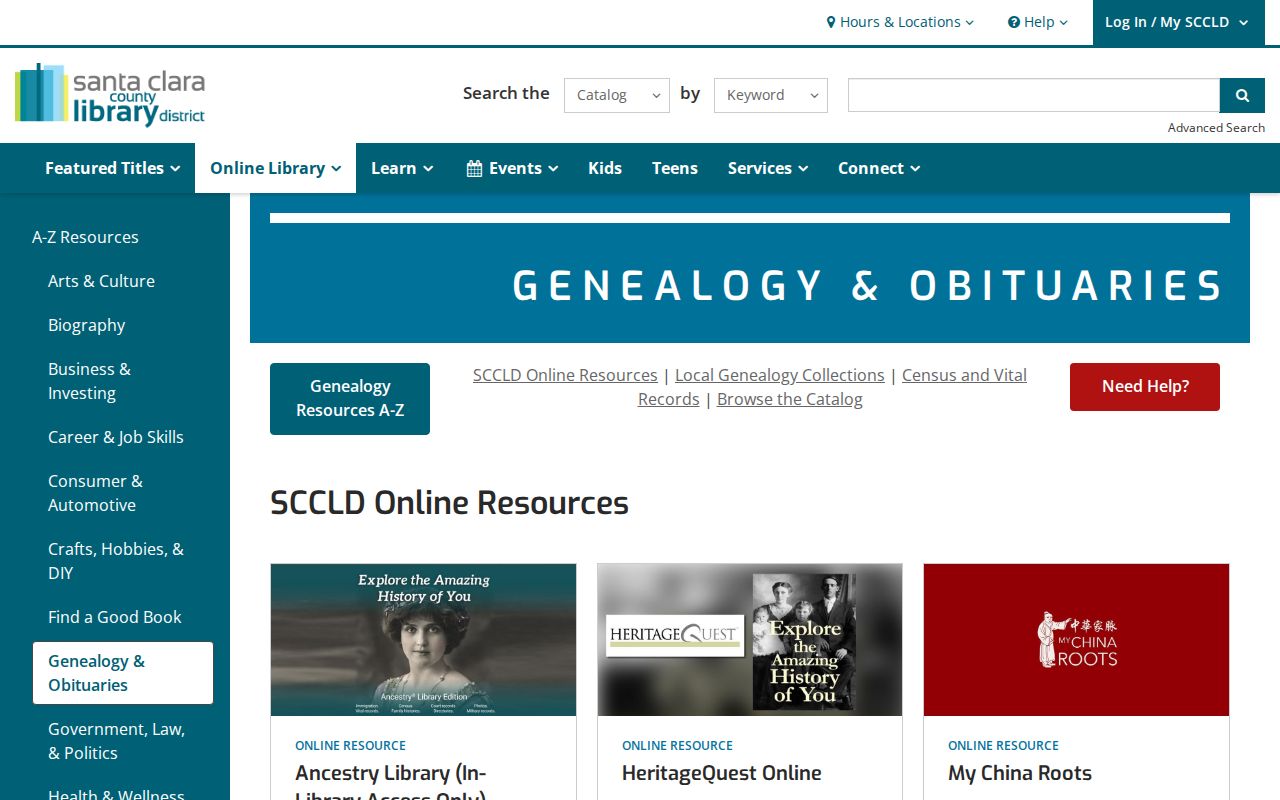
The genealogy resources image points to the access layer behind a historical directory search: catalog records, licensed databases, and reference help may sit in different systems. Save the volume title and date before moving to another source.
San Jose Volumes That Include Campbell
San Jose Public Library’s California Room confirms full regional directories for 1870 and 1887. Its 1887 volume reaches towns in Santa Clara, San Mateo, and Santa Cruz counties, which explains why a Campbell household may appear even when the title does not put Campbell on its cover. The 1920 Polk-Husted San Jose City and Santa Clara County Directory contains 601 images. It is a substantial regional source, but it should still be cited as the 1920 edition rather than treated as a continuous Campbell series.
The same digital collection includes business-classified sections for 1890, 1892-1913, and 1915-1918. Classified pages can reveal a firm, proprietor, trade, or place name, yet they do not supply the full resident coverage of an alphabetical directory. Use a classified hit to form a lead, then seek a resident page, newspaper notice, deed, or museum item that confirms the person and place. The source description also points to print and microfilm directory volumes, Haines Criss Cross volumes, and telephone books.
Optical character recognition (OCR) adds another caution. The 1887 pages show surname and given name, honorific, status, business or employer, residence marked by res, postal locality marked by p o, and sometimes orchard or acreage facts. Browse the scanned page when OCR drops a name, turns an initial into a letter, or breaks a street name. Search variants, spouse names, and neighboring entries, while keeping the image citation for the final note.
Reading Campbell City Directory Entries
A Campbell city directory entry is a compact set of clues, not a certificate of residence. The usual order is surname, given name or initial, spouse in parentheses when supplied, a historical occupation or business affiliation, home address, and short marks. The exact volume controls. Read its title and abbreviation pages first, because one publisher’s key may not apply to another publisher’s edition.
| Name | Surname followed by given name or initial; same-surname entries group together. |
|---|---|
| Family clue | A spouse may appear in parentheses; wid can mark a widow or widower relationship. |
| Occupation or business | Historical occupation, employer, or business name; propr may mean proprietor. |
| Home address | h can mark home or householder; r can mean resides, rooms, or a residence line. |
| Other marks | emp can identify an employer or business connection; verify every short form in the volume key. |
- Criss-cross directory
- A reverse directory arranged by street and number, then a listed occupant or telephone subscriber.
- Householder index
- An alphabetical entry point for a household name, often leading to a home address or related listing.
- Abbreviation key
- The publisher’s own glossary of short marks. Photograph or transcribe it before reading entries.
Read the name, address, and mark as one unit. A repeated address can suggest co-residence, while wid or a spouse note can suggest family context, but the printed line remains a historical clue. Preserve the page image and the key that made the abbreviation legible.
Campbell Directory Pages Run Two Ways
Alphabetical pages answer a name-first question. Start with the surname, test initials and spelling variants, and note the spouse, historical occupation, and address printed beside the name. A repeated address can suggest a shared household, but it does not prove a relationship. A person who changed names may appear under a spouse, trust, business, or a shortened form.
Reverse or criss-cross pages answer an address-first question. Move to the street, read the house numbers in sequence, and copy each listed occupant or telephone subscriber. This can reveal a prior householder or a change in the listed adult between editions. It cannot show every child, renter, lodger, or unlisted telephone customer. A street line can also change when a boundary, subdivision, or spelling changes.
For Campbell, use both directions in the same edition when possible. First locate a name alphabetically, then test that address in the reverse section. Next compare adjacent years. The result is stronger when the name, street, and a second source agree, and weaker when only one line appears in a volume with known gaps or noisy scanning.
Campbell’s 1952 Directory Geography Shift
Local record story. Campbell incorporated in 1952. Earlier households may therefore be indexed under a Campbell precinct or township, a San Jose vicinity, a rural route, or Santa Clara County rather than under the modern city name. That filing change is a geography problem, not evidence that a household was missing. It also explains why a regional directory can be more useful than a narrow search for the word Campbell.
Campbell’s older orchard and rural landscape left names in subdivision descriptions, telephone exchanges, newspaper notices, and county map context before a modern street number became stable. County Map Books cover about 1850-1957 in roughly 5,900 maps across 108 volumes, with documented gaps, and can help connect an older subdivision or survey to later directory geography. Search the place label used in the edition, then compare the printed address with a later street form. Keep the original spelling and the source date. Do not infer a family link from a surname or assume that two people with the same address were related.
The Santa Clara County Map Books archive is a supporting geography source, not a resident directory. Its maps help explain why a household can move from a county or rural heading into a Campbell heading without any break in the underlying place.
Campbell Yearbooks, Papers, and Museum Files
Yearbooks can fill the gap when a person was a student rather than a listed adult. Campbell Library’s Del Mar High Laurel run starts in 1989 and is missing 1990, 1991, and 1993. Westmont High Poniard runs from 1979 forward, with gaps in 1984-1986, 1990-1991, 1999, and 2005-2006. Campbell High opened September 14, 1900 and closed in June 1980. Ancestry access is in-library only. A yearbook name, class, or activity can help distinguish two people before a directory address is treated as a match.
Campbell Museums and Ainsley House collections add family, business, building, photograph, and ephemera context. The partial catalog gains records weekly; the full database is available by appointment. Newspaper holdings include Campbell Press issues from 1904, 1906, 1945-1973, and 1975-1985, plus Weekly Visitor issues from 1895, 1896, and 1904. Some material is on Archive.org while other material is museum-only. About 100 oral histories exist, many digitized or transcribed.
Museum image requests use the Object ID, contact details, photo-permission information, and an invoice step. Research contact is 51 N. Central Avenue, 408-866-2119. A museum photograph can show a storefront, family, or building, but the item record and its date control what it proves.
The Campbell Museums portal gives a visual sense of the local-history layer that can sit beside a historical directory.
The museum image is a prompt to pair a directory line with an item-level source, not a substitute for the volume, page, Object ID, and date that make a historical claim traceable.
Trace Campbell Families Across Directory Years
Use neighboring editions to turn a single Campbell volume entry into a cautious household timeline. The newest public individual federal census is 1950 under the 72-year release rule, so census pairing works best for earlier eras and must respect the enumeration geography in the schedule. The Census profile for Campbell is a modern geography reference, not a substitute for the released schedule. A directory lists only what its publisher collected; a census records one official enumeration date. Neither fills every gap between editions.
- Find the first plausible name in the alphabetical section and write down every mark, address, spouse clue, and page number.
- Check the reverse section for the same street and number, then compare the prior and next available editions.
- Search the Campbell Library catalog for newspapers, yearbooks, and telephone volumes that overlap the move or arrival.
- Pair a directory year with a released census schedule, using enumeration district maps when street names or boundaries differ.
- Test a departure with an obituary, vital-record index, cemetery source, probate case, or deed record rather than treating silence as proof.
A name that disappears may reflect a move, death, a missing volume, a changed spelling, a new boundary, or a publisher’s limited canvass. Record “not listed” until another source supplies the reason. When a directory clue needs modern confirmation, a Campbell resident lookup can be paired with the historical citation instead of replacing it.
For every Campbell volume citation, retain the publisher, exact edition, page or image number, section, and abbreviation key used. That small habit keeps a regional clue separate from a proven identity.