
Campbell Address History by Era
A Campbell address has no single historical resident file. Ownership instruments, parcel maps, city permits, directories, census schedules, newspapers, and probate each preserve a different slice. The era table sets the order of attack. Begin with the current situs address and APN, then choose the source that covers the period being tested. A listed name is evidence of a published entry, while a deed party is evidence of a recorded transaction. Neither alone proves who slept at the address.
| Source | Years | Where | Evidence |
|---|---|---|---|
| Official real-estate records | 1850-present | Santa Clara County Clerk-Recorder | Deeds and other recorded instruments; Digital Reel/books 1850-1980, workstation 1981-present |
| County Map Books | Circa 1850-1957 | County Archives and Open Data | About 5,900 subdivision, survey, cemetery, and approval maps in 108 volumes with gaps |
| Assessor parcel search | Current portal | Santa Clara County Assessor | Campbell situs address, APN, property facts, and latest title-changing document bridge |
| Campbell permits and planning files | New MGO intake since May 4, 2020; older files separate | Campbell Building and Planning | Address, project history, and public applicant or contact fields where releasable |
| City, telephone, and reverse directories | Edition-specific | Campbell Library and regional catalogs | Listed occupants or subscribers; exact Campbell run requires a catalog check |
| Federal population census | Through 1950 public | NARA and partner library databases | Household at an enumeration date, with geography and page context |
| Obituaries and probate | Title or case-specific | Libraries, museums, newspapers, and Superior Court | Death, family, heir, and estate clues that can close an older trail |
For a recent change, permits and the deed chain usually lead. For an older household, a reverse directory or census page may be more informative than an ownership record. For a person who died or left an estate, an obituary and probate case can connect a name to heirs or a later transfer. The right start depends on the date, not just the street.
Start Campbell Previous Residents with the APN
The Santa Clara County Assessor begins with an exact Campbell situs address or APN. A situs address is the physical parcel location; an APN, or assessor’s parcel number, is the county identifier tied to that parcel. Its public real-property search accepts a simple address, structured address, or APN, but it does not offer a public owner-name search. Do not enter the tax mailing address as though it were the physical location. The result supplies the parcel bridge and can identify the latest title-changing document number used for recorder research.
- Normalize the street number, direction, street name, suffix, unit, and city. Confirm that the parcel is in Campbell rather than relying on a postal label.
- Search the Santa Clara County Assessor property portal by situs address or APN, accept its terms, and record the APN and displayed title-document bridge.
- Take the document number to the Clerk-Recorder workstation at 110 W. Tasman Drive, First Floor, San Jose. The recorder does not index deeds by street address.
- Read the instrument for buyer or grantee, seller or grantor, recording date, document class, and legal description. Search the seller as an earlier grantee.
- Repeat the seller-to-earlier-purchase step, switching from workstation research to Digital Reel or books for the 1850-1980 span.
This method turns an address into a chain of title, which is the sequence of recorded transfers affecting the parcel. It tracks ownership, not a complete list of past residents. A deed may name a trust, spouse, estate, or business and may use a legal description that stays stable while the street text changes.
- Grantor
- The party conveying or transferring an interest in the recorded instrument.
- Grantee
- The party receiving that interest. Searching the earlier seller as grantee can reveal the prior purchase.
- Legal description
- The land description in the deed, such as a subdivision or lot reference, used to match older records beyond street wording.
Follow Grantors Through Campbell’s Deed Chain
Santa Clara County real-estate records begin in 1850. The official research path is office-based because the county removed its public online Official Record Index on November 5, 2018. The recorder’s search keys are document number, document date, document class, APN, grantor, grantee, or a combined party search. A street address is not an index key. Before May 1, 1995, book and page may be the working locator, so preserve both the modern instrument number and any older citation.
At 110 W. Tasman Drive, public workstations cover 1981-present. Digital Reel and book methods cover 1850-1980. Bring identification for book or microfiche work. The office is generally open Monday through Friday, 8:00 a.m. to 4:30 p.m. Busy workstations can be limited to one hour, and arriving early is the county’s practical advice. Search names as indexed, then try initials, spouse names, trust names, and spelling variants when the chain breaks.
Copies can be ordered at the counter, by email, or by mail. A plain copy is $4 for the first page and $2 for each additional page; certification adds $2 per document. The card fee is $2.50 at the counter or $6 for an email request. Processing can take up to seven business days, and official records are not emailed. Use the county deed-chain research instructions for the current workstation and Digital Reel path, then use the copy-order channel when a document number or book/page is known.
Campbell Previous Residents Across the 1981 Cutoff
Numbers that shape the search. The 1850 start date and 1981 technology divide are not just catalog facts. They determine where a previous-resident search happens. A post-1981 chain begins at a public office workstation. A 1980 or earlier chain may require Digital Reel or annual grantor-grantee books. The 2018 online-index removal means a search engine result cannot stand in for the county’s official record research.
Plan a recorder visit around the one-hour workstation possibility. Bring the APN, latest title-changing document number, likely party names, and the date range. If the first deed is older than the online-era material, move to the reel or books rather than forcing an address search. If the chain reaches a deed before May 1, 1995, keep the book/page reference with the copy request. These details make a gap explainable rather than mysterious.
Insider tip. Arrive early at the recorder. A busy public workstation may be limited to one hour, so an organized APN-to-seller chain preserves the most search time.
Pair Campbell Owners with Listed Occupants
Owners are only one layer of previous residents. Campbell city directories, telephone books, and reverse or criss-cross directories can place a listed adult or subscriber at a street number for a particular edition. They show listed occupants only, not a complete household. Their entries use surname and given name, a spouse clue in parentheses, historical occupation or business information, home address, and short marks such as h, r, emp, wid, or propr. Read the exact volume’s abbreviation key before interpreting a line.
Reverse directories run by street and number to an occupant or subscriber. They can show a change between editions, but they omit children, many unlisted occupants, some lodgers, and people outside the publisher’s canvass. Changed spellings, boundary shifts, and gaps in the run can look like a move. A directory name should be paired with the deed chain, census, newspaper, or another dated source before it is treated as a person-to-address match.
The historical collection itself is described on the Campbell city directory page. Keep this address-history question separate: the city directory shelf explains how a volume works, while previous-resident research uses a volume to test one parcel’s past.
Use the 1950 Census for Campbell Households
As of 2026, 1950 is the newest public federal census with individual schedules under the 72-year release rule. Census pages can show a household at one enumeration date, which is often closer to an occupancy question than a deed. They still require care. Campbell incorporated in 1952, so earlier records may use a precinct, township, San Jose vicinity, rural route, or Santa Clara County label. Enumeration district maps can bridge the street to the correct page.
Pair a directory year near 1950 with the matching census schedule, then compare the names, ages, relationships, street wording, and neighboring entries. A mismatch can reflect a move between dates, a renamed or renumbered street, a missed listing, or a boundary change. The National Archives census guidance explains the release framework and access path; a library database may supply a different index or image view.
Use the household record as a dated snapshot. It does not prove that every person remained at the address, and it cannot fill years that were never released. An absent name should lead to a second edition, newspaper, obituary, or probate search rather than a conclusion that no one lived there.
Date Campbell Addresses with Permits and Maps
Campbell’s property and permit history can explain why an address trail changes. New building applications have used MyGovernmentOnline, or MGO, since May 4, 2020. Modern applications require an account to submit, while the city’s property and planning pages direct researchers to address-based history. Ask Building for legacy scans or microfiche by exact address and permit type. A file may contain an applicant, contractor, owner, or project contact where public, but a permit name is not automatically a resident name.
The Santa Clara County Map Books collection reaches roughly 1850-1957 and includes about 5,900 maps in 108 volumes, with subdivisions, surveys, cemetery plans, and approval context. Missing volume numbers are a catalog issue to investigate, not proof that a map or household did not exist. Compare the map’s subdivision or legal description with the deed and APN.
Sanborn fire-insurance maps may help date a building footprint, use, or material, but the exact Campbell sheets and years were not verified in the official material reviewed. Treat a Sanborn hit as a catalog lead until a library or archive confirms the edition.
The map-book collection is especially useful when a modern street number did not yet exist.
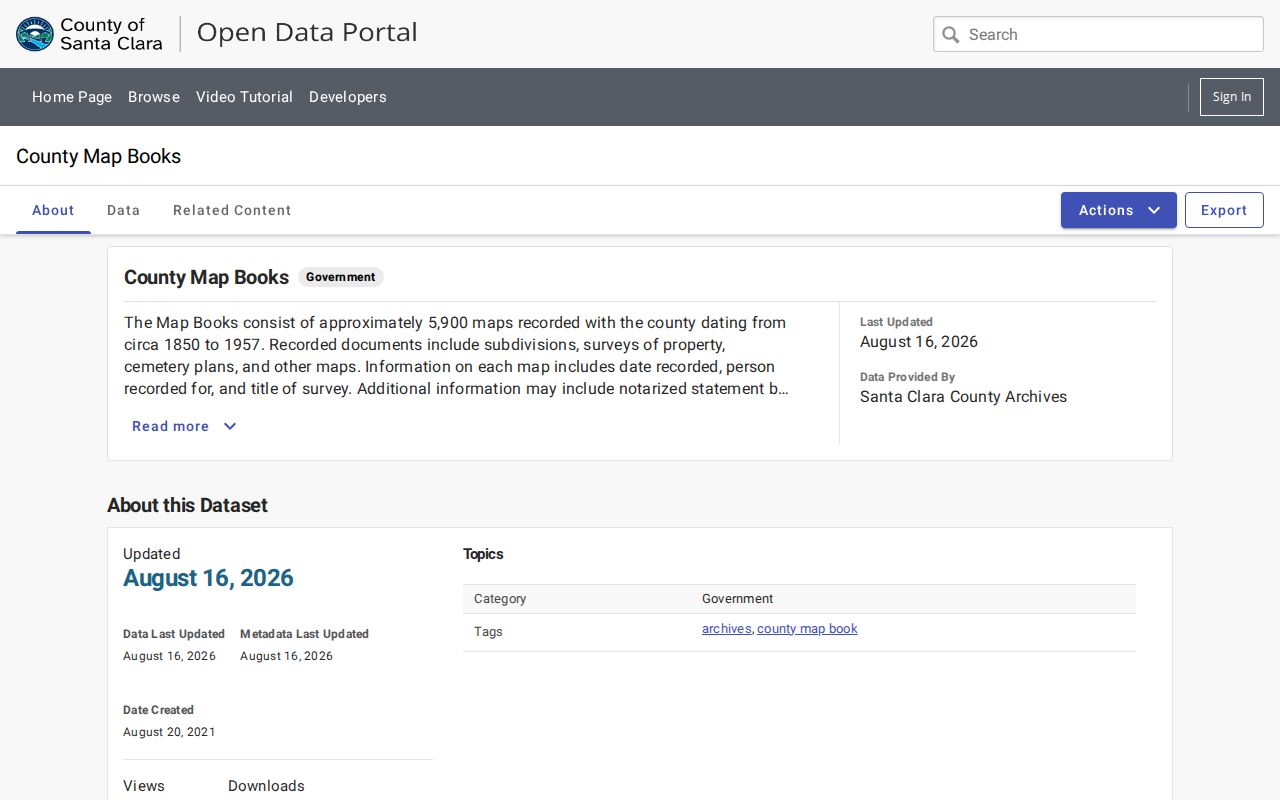
The image represents the historical map layer that can connect a Campbell parcel to a subdivision or survey. Confirm the map against the primary deed, because open-data geometry is orientation evidence rather than a legal boundary survey.
Find Heirs of Campbell Past Residents
Probate and deeds can meet at the end of a previous-resident trail. A former owner’s probate case may name a decedent, representative, petition, will, or heirs where the public file permits. A later recorded transfer can then show how an interest moved. Search the Santa Clara Superior Court public portal for supported case information, and use the clerk or courthouse terminal when the online result does not supply the needed document. Probate is a court record, not a Clerk-Recorder real-estate series.
Newspaper obituaries, cemetery records, and Campbell Museums or library collections can supply a date, spouse, child, or former address. The Campbell Press and Weekly Visitor runs are title-specific, and museum material may be on Archive.org or available only by appointment. A funeral notice is a lead, not a substitute for a vital record or court file. Record the publication title, date, page, and item or case identifier.
The strongest endpoint is a concordant chain: deed party, dated directory or census entry, obituary or probate clue, and later transfer. Even then, say what the sources show. Do not turn an heir clue into a claim about a current occupant.
Campbell Address Numbers Can Change
Local addressing quirk. Campbell applicants may propose street names or numbers, but Building makes the final numbering decision under Campbell Municipal Code (CMC) chapter 18.36. A remodel, subdivision, annexation, or unit change can therefore break a search that uses only modern street text. Match the APN, legal description, subdivision, map, and older street form before declaring that two addresses are different properties.
Campbell’s incorporation in 1952 and later annexation history also affect the custodian. San Tomas, for example, was largely developed in the 1940s and 1950s but incorporated only in the 1980s. Older permits or address records may route to the county even when a current parcel is understood as Campbell. Treat jurisdiction as a date-specific question and keep the old geography in the citation.
Campbell Previous Residents and Privacy Limits
A previous-resident search has hard limits. A deed identifies recorded parties, not every occupant. A directory shows listed people only. DMV and utility customer records are protected, voter information is purpose-restricted, and Safe at Home can give qualifying people a substitute mailing address. A missing public name is not proof that a person was absent from Campbell.
Use a focused request when a city record is needed: identify the address, department, record type, and date range. Campbell’s public-record process covers existing records and can redact protected material; it does not require the city to create a new answer. Verify a suspicious deed-copy solicitation or estate claim through the custodian’s published channel.
Lawful personal use. Campbell previous-resident research is appropriate for house history, family history, genealogy, and personal curiosity. Public availability does not permit stalking, harassment, threats, or attempts to defeat a protected address.